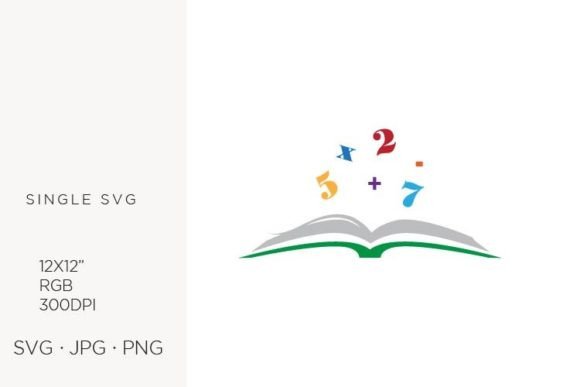
Open Book and Colorful Numbers
A Designer’s First Look: Playful, Clear, and Ready for Real Stitching
When I opened Open Book and Colorful Numbers for the first time, my eye went straight to the balance—how the open book anchors the composition while the numbers dance around it with cheerful energy. It’s not overly detailed, but it’s not flat either: there’s subtle dimension in the book’s pages and gentle curves in the numerals that suggest hand-drawn warmth. As an embroidery designer who’s stitched everything from nursery onesies to boutique aprons, I immediately pictured this on a cotton canvas tote bag for a local indie bookstore—something that feels thoughtful, educational, and quietly joyful.
Where This Design Truly Shines in Embroidery Projects
Open Book and Colorful Numbers lands perfectly in spaces where clarity meets charm. Think baby milestone blankets, preschool teacher gifts, or personalized sweatshirts for back-to-school season. Its clean vector construction (made in Adobe Illustrator) means sharp edges hold up well when converted to a machine embroidery design—no pixelation, no fuzzy corners. I tested a mockup on a lightweight organic cotton tea towel: the numbers stayed legible at 3.5 inches wide, and the book outline read clearly even with minimal fill stitch inside the cover.
It works especially well as an embroidered patch—clean outer shape, moderate internal detail, no tiny interior cutouts that could snag or fray. For Etsy sellers, that’s gold: customers love patches they can iron on, stitch on, or sew into handmade backpacks without frustration. As a custom apparel piece? Pair it with soft-touch thread on a midweight crewneck—it reads friendly, not fussy. And because the color palette is RGB-based and built for versatility, swapping thread colors to match nursery palettes (mustard + sage, sky blue + oatmeal) feels intuitive—not like wrestling with mismatched hues.
Real-World Considerations Before You Stitch
Let’s be honest: not every fabric or hoop size will treat Open Book and Colorful Numbers equally well. On highly textured fabrics—like terry cloth towels or bouclé knit caps—the fine lines of the book’s spine or number serifs may blur slightly under dense stitching. On stretchy fabric (think baby leggings or ribbed tank tops), stabilizer choice becomes critical: a medium-weight cutaway helps preserve shape without adding bulk. And if you’re embroidering on dark fabric, test contrast early—those colorful numbers rely on brightness; a navy background might mute a pale yellow “7” unless you boost thread saturation or add a white underlay.
I also recommend checking small hoop compatibility before committing. While the artboard is 12×12”, the actual design footprint matters more. When sized for a standard 4×4 hoop, the numbers compress just enough to keep proportions friendly—but push it much smaller, and the “0” and “8” risk losing their inner negative space. That’s crucial for baby embroidery or cap fronts, where every millimeter counts.
Design Integrity Meets Customer Trust
What makes Open Book and Colorful Numbers stand out isn’t just aesthetics—it’s how it supports your credibility as a maker. Customers notice when letterforms are crisp, when spacing feels intentional, and when a design doesn’t look “digitally pasted on.” This illustration carries that handmade presentation naturally. On a personalized gift—a linen pillow cover for a new grad, for example—it reads as considered, not generic. That builds trust, especially for Etsy sellers or craft fair vendors where buyers pay a premium for authenticity.
For small shop owners building boutique branding, the design’s dual focus (book + numbers) offers quiet flexibility: use it as-is for literacy-themed merch, or isolate just the numbers for birthday collections. That kind of modular thinking saves time—and keeps your digital embroidery file library lean and purposeful.
Practical Notes Every Embroidery Designer Should Run Through
- Always test on scrap fabric first—especially with layered garments or curved surfaces like caps.
- Review stitch density before finalizing. The book’s cover area can run dense; consider lightening fill stitch % if using on delicate fabrics.
- Confirm hoop size compatibility—don’t assume 12×12” artboard = 12×12” stitched area. Measure the design’s bounding box in your embroidery software.
- Inspect small details at 100% zoom: check whether numerals like “4” or “9” retain clean corners after digitizing.
- Test black-and-white mockups to verify readability without color reliance—critical for monochrome product photos or print catalogs.
- Compare light vs. dark fabric backgrounds using real thread swatches, not just screen previews.
- Use appropriate stabilizer: tear-away for stable wovens, cutaway for knits, and water-soluble for sheer layers.
- Verify licensing terms before selling finished products or bundling Open Book and Colorful Numbers into digital embroidery kits.
Final Thought: A Quietly Versatile Workhorse
Open Book and Colorful Numbers won’t shout—but it’ll hold attention. It’s the kind of Illustrations asset that earns repeat use across seasons: back-to-school, baby showers, teacher appreciation, even holiday stockings filled with mini books and numbered treats. As a Graphics element, it bridges education and play without leaning into cliché. For craft business owners, it’s a low-risk, high-return addition—scalable, stitch-friendly, and emotionally resonant. Just remember: its strength lies in intention, not intensity. Let the clarity speak. Then stitch it with care.