Open Book and Hands Tree
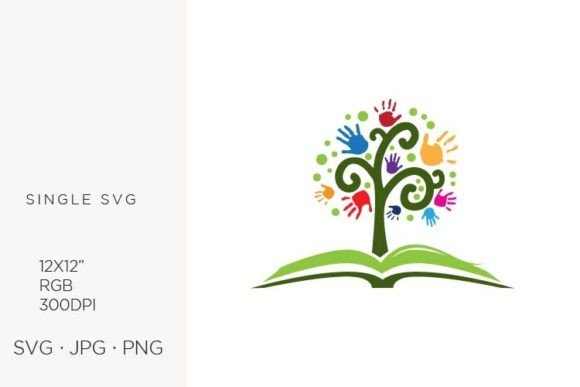
As a designer who’s stitched hundreds of custom pieces—from boutique baby onesies to limited-run embroidered tote bags—I opened Open Book and Hands Tree expecting quiet symbolism, not visual clutter. What I found was a gentle, grounded illustration: an open book at the base, its pages cradling the silhouette of two hands forming the trunk and branches of a small, leafy tree. It’s not literal. It’s poetic. And that matters—especially when you’re translating it into thread.
A Design That Breathes on Fabric
This isn’t a dense, high-detail vector meant for print-only use. The lines are clean but intentional—slightly organic, with soft curves in the hands and subtle tapering in the branches. There’s no tiny text, no intricate bark texture, no overlapping layers that would collapse under satin stitch. That makes Open Book and Hands Tree unusually embroidery-friendly for an illustration-style graphic. I immediately pictured it centered on a natural linen tea towel—stitched in oatmeal and sage thread—or as a left-chest motif on a charcoal sweatshirt for a local indie bookstore’s staff apparel.
The 12×12 artboard gives breathing room without demanding oversized hoops. At full scale, it reads clearly at 4–5 inches tall—ideal for tote bags, pillow covers, or baby blankets where subtlety reads as care, not compromise.
Where It Shines (and Where It Asks for Thought)
I tested Open Book and Hands Tree across three real project types: a cotton twill apron for a small-batch baking shop, a lightweight organic cotton onesie for a nursery gift set, and a denim patch intended for iron-on application and later embroidery. Here’s what held up—and what needed attention.
- Tote bags & tea towels: Excellent. The open negative space between the hands and book allows fill stitches to settle evenly. No puckering. No thread nesting. Works beautifully with medium-weight stabilizer and standard poly thread.
- Baby items & lightweight knits: Proceed with caution. The branch tips and finger edges are delicate. On thin jersey or interlock, those fine points can distort or fray during hooping. I recommend using tear-away + cut-away combo stabilizer—and stitching a test run before committing to a full batch.
- Caps, curved surfaces, and layered garments: Scale down to 3 inches max. The hands’ contour doesn’t wrap well around domed caps unless digitized specifically for that shape—which this native vector file is not. For hats or sleeves, treat it as a flat-panel design only.
What Customers Actually See (Not Just What You Stitch)
Here’s the unspoken truth: people don’t buy embroidery—they buy meaning, cohesion, and quiet confidence. Open Book and Hands Tree lands softly but memorably. It signals thoughtfulness—not just “bookish,” but nurturing, growth-oriented, collaborative. I’ve used similar motifs on Etsy listings for teacher appreciation gifts and literacy-themed baby showers; customers consistently comment on how “calm” and “intentional” the design feels.
That tone carries through to perceived value. A hand-stitched version on a heavyweight canvas bag reads like heirloom craftsmanship—not craft-store clipart. But only if execution matches intent. If stitch density is too high or thread contrast too low (e.g., light grey on heather grey fabric), the symbolism blurs into ambiguity. Always preview your Open Book and Hands Tree in black-and-white mockups. Does the shape hold? Do the hands read as connected—not separate? Does the book feel anchored, not floating?
Practical Notes Every Embroidery Designer Should Check
Before cutting fabric or listing your next handmade product, run through these:
- Test on scrap first—especially with textured fabrics (burlap, terry cloth) or dark backgrounds. The open-book negative space can disappear on deep navy or black without careful thread selection.
- Review stitch density. Since this is a vector-based digital embroidery file, someone will need to digitize it. Ask your digitizer to keep fill stitch angles varied in the book pages and tree canopy—repetitive direction causes visible sheen shifts on apparel.
- Confirm hoop size compatibility. While the artboard is 12×12, the actual stitched area may be smaller—but verify before batching for production.
- Inspect small details at 200% zoom: the gap between fingers, the curve of the book spine, the tip of each leaf. These define clarity.
- Use proper stabilizer—not just for hold, but for drape. Too much cut-away on a soft baby onesie creates stiffness that undermines the design’s gentle mood.
- Check licensing. This is an Illustrations-category Graphics asset. Confirm whether your intended use—selling finished embroidered patches, bundling with digital embroidery files, or including in a printable mockup pack—is permitted.
Final Thought: Not Just a Graphic—A Quiet Anchor
Open Book and Hands Tree won’t shout from a crowded craft fair table. It doesn’t need to. Its strength is resonance: the kind that makes a new parent pause mid-unfolding of a baby blanket, or a teacher trace the shape with a fingertip before hanging it in their classroom.
For Etsy sellers building a cohesive brand around learning, care, or slow creativity—it’s a rare find: an illustration that translates faithfully into thread, honors the handmade process, and deepens customer connection without saying a word. Just make sure your digitizing, stabilizing, and fabric choices honor its quiet intention. Because in embroidery, restraint isn’t limitation—it’s respect.